Turn your food catalogue into a growth engine.
Whatever their diet, your visitors should find what they can actually buy. Automate the analysis of your products and give your most demanding customers a shopping experience they can trust, with no connector to install.
Prevalence: EAACI, 2015.
+18%
Average basket, allergy segment
-73%
Inbound allergen support tickets
24h
To qualify your entire catalogue
99.2%
Detection accuracy, all allergens
Your allergen catalogue, finally under control.
Turn raw ingredient lists into certified data. Automate the enrichment of your product listings, make your filters reliable and give your customers full transparency.
From raw data to product intelligence
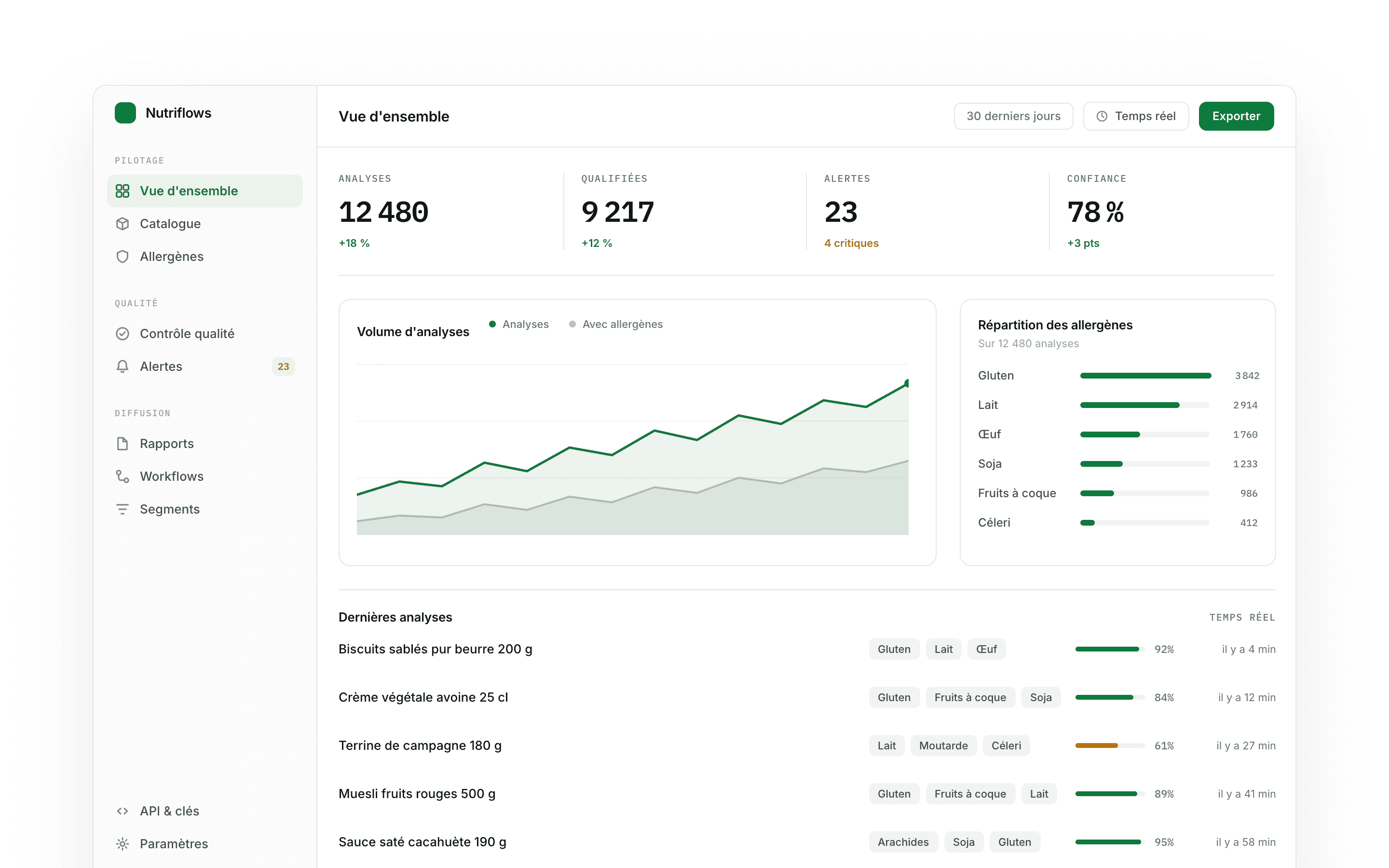
Turn your raw lists into a structured database. Our AI normalises your products and instantly generates their attributes (lactose, gluten, vegetarian, etc.).
What's in "Wheat flour"?
CLASSIFICATION
Standardised as:
Attributes
Auto-managed tags:
Switch on smart filters
Make your search engine 100% functional in a single click.
Croissant
Quinoa salad
From insight to automated action
Segment your products and trigger smart workflows. Whether it's alerting your team on Slack, assigning a fix or tagging a product, turn your analyses into operational results.
Alert sent to #alerts
Task created for @team
Compliance: zero risk, 100% compliant
See your catalogue's reliability score in real time, get alerts on at-risk products and generate your official reports in a few clicks.
Full EU FIC report
Compliance audit • Jan. 2027
24,500
Products tested
100%
Allergens covered
Geographic coverage
Resolved alerts
Export the certified report
Key alert history
View allPeanut traces not specified
Ref: #A8934 (Cereal bar)
Ingredient format to review
Ref: #C1290 (Soy sauce)
Products tested
Score: 99.8% ▾Getting started
From supplier sheet to alert, hands-free
You install nothing. Your catalogue arrives exactly as it leaves your PIM, and the results go back to where your team already works.
Exactly as the supplier entered it, rough edges included.


 export · webhook
Ingredients, claims and trace statements, right down to the free text, where allergens hide most often.
The 14 Annex II substances, compared with the diet tags already set on the listing.
Tagged “lactose-free”, first ingredient: milk.
Nothing to report, the product goes live.
The product, the discrepancy and the excerpt that triggered it.
What was blocked and what went through, on one page.

 email
Allow 24 hours for a full catalogue, then continuous monitoring of every update. The full contract (response envelope, allergen identifiers, confidence thresholds) is in the API documentation.
Simple, Powerful API
Three endpoints to cover all your allergen detection needs.
/api/allergens/analyzeAnalyze a single product or batch of products to detect allergens with confidence scores.
// Analyze a product for allergens
const response = await fetch('/api/allergens/analyze', {
  method: 'POST',
  headers: { 'Content-Type': 'application/json' },
  body: JSON.stringify({
    productName: 'Chocolate Chip Cookies',
    ingredients: 'Wheat flour, butter, chocolate chips, eggs, sugar, vanilla'
  })
});

const result = await response.json();
// Returns: { allergens: ['gluten', 'dairy', 'eggs'], confidence: 95 }
Six things a spreadsheet will never catch
Each check confronts what a product page displays with what its ingredient list says. Five expose you, one pays you back, and all six were found on real online catalogues.
The contradicting tag
The listing shows
The ingredients say
pasteurised MILK, salt, cultures…
Your “lactose-free” filter serves this product to someone who must not eat it.
Online organic grocer · dairy aisle
The buried allergen
Allergen field
Free text
WHEAT flour, skimmed MILK, MUSTARD
Only the capital letters give it away. No filter reads capital letters.
Online grocery platform · 4 allergens
The bare claim
Front of pack
Allergen declaration
It is the first thing an inspection looks at, and the easiest to establish.
Producers' marketplace
The empty field
Allergen field
Ingredients
eggs, butter, tree nuts
An empty field is not an absence of allergens. It gets read as one.
Two retailers · including a national chain
The false friend
The listing shows
Precautionary statement
may contain traces of gluten
“Naturally free from” does not mean “free from”. That nuance is paid for in a product recall.
Organic store network · snacks aisle
The dormant inventory
Eligible for the filter
596
Actually tagged · 19%
114
The filter exists. The shelf is empty. The customer buys it elsewhere.
One audited catalogue · near-systematic gap
Only one of the audited catalogues had no discrepancies.
It belonged to a retailer already paying a provider to do this. Everywhere else, the same pattern: products perfectly eligible for a filter the shop already offers, yet nobody tagged them. 596 on one side, 114 on the other. Enter your GMV and the share of your catalogue concerned to estimate what that gap costs you.
Calculate my ROIPlans built for every catalogue size.
From 5,000 to 80,000+ products: every listing checked, not a sample.
Starter
5,000 products · 15,000 analyses/month
- 14 major EU allergens
- API + CSV integration
- Compliance dashboard
- Safe-to-Eat filter, ready to switch on
- Email support (48h)
- Overage: €0.025 per extra analysis
Growth
15,000 products · 60,000 analyses/month
- Everything in Starter +
- Traces & cross-contamination
- Native Akeneo / Mirakl integration
- Automatic re-analysis alerts
- Exportable DGCCRF reports
- Priority support (8h)
- Overage: €0.018 per extra analysis
Scale
80,000 products · 250,000 analyses/month
- Everything in Growth +
- Multi-country & multilingual (14 languages)
- EFSA reports + certified audit
- Advanced automation workflows
- Dedicated CSM + guided onboarding
- 99.9% SLA · 4h support
- Overage: €0.012 per extra analysis
Enterprise
Negotiated volume
- Everything in Scale +
- On-premise / VPC available
- Custom ERP integration
- DPA + contractual SLA
- Dedicated quarterly review
- Priority API access & custom rate limits
- Team training included
Frequently asked questions
Got another question? Talk to an expert
See Nutriflows at work on your own data.
In 30 minutes, we connect Nutriflows to your PIM and you watch your first products get qualified, live.
FAQs
Everything you need to know about Nutriflows
Can't find your answer? Get in touch with our support team
What is Nutriflows?
Nutriflows is an API that detects and structures allergen data for food catalogues. It lets marketplaces and online food retailers automatically identify allergens such as gluten, lactose or peanuts. The result: better regulatory compliance, less risk for consumers and more trust from customers.